The unit was running non stop and never quite reaching its setting. He weighed in the charge properly after the repair instead of guessing on gauge pressure, which the last firm did not bother with.
Alaric M.2026-06-27
Independent Sub-Zero specialists · Fleming Island, Clay County
Monday – Friday 8:00am – 6:00pm Call (904) 201-3304
When a fifteen-year-old Sub-Zero built-in is worth repairing and when it is not, and what an independent shop looks at before quoting compressor work.
There is a point in the life of every built-in refrigerator where the next repair has to be argued for rather than assumed, and the honest version of that argument is not one a repair company benefits from having. We would rather have it anyway, because the alternative is a customer who spends real money on a cabinet that was finished.
A freestanding refrigerator is a commodity. When one needs an expensive part, the calculation is short, because a replacement costs what the repair costs plus a bit.
A built-in is not that. It is fitted to an opening, carries a custom panel, was installed by trades who are no longer on site, and its replacement is a project rather than a purchase — the unit, the delivery, the panel, possibly cabinetry work if the opening no longer matches what is available. That is why an expensive repair on a built-in is frequently still the right decision at an age where nobody would consider it on a freestanding unit.
It also means age alone is a poor guide. Twenty years is not old for a cabinet of this type. What matters is which part of it has failed.
Fans, gaskets, hinges, door closers, defrost components, ice maker assemblies, drain lines, thermistors and sensors, and the ordinary cleaning of a choked condenser. These are wear items on a machine designed to have them replaced. They are modest amounts of money, they restore the appliance completely, and they will keep an otherwise sound built-in running for years.
If you are being told that a fifteen-year-old built-in should be replaced because it needs a fan motor and a set of seals, get another opinion.
Control boards sit slightly above that line — they are not cheap — but on a cabinet that is otherwise sound they are usually still the right call. The caution here is diagnostic rather than economic: a board should be replaced because it has been shown to be failing, not because it is the most convenient explanation. On older kitchens we measure the supply voltage under load first, because a starved circuit imitates a bad board convincingly.
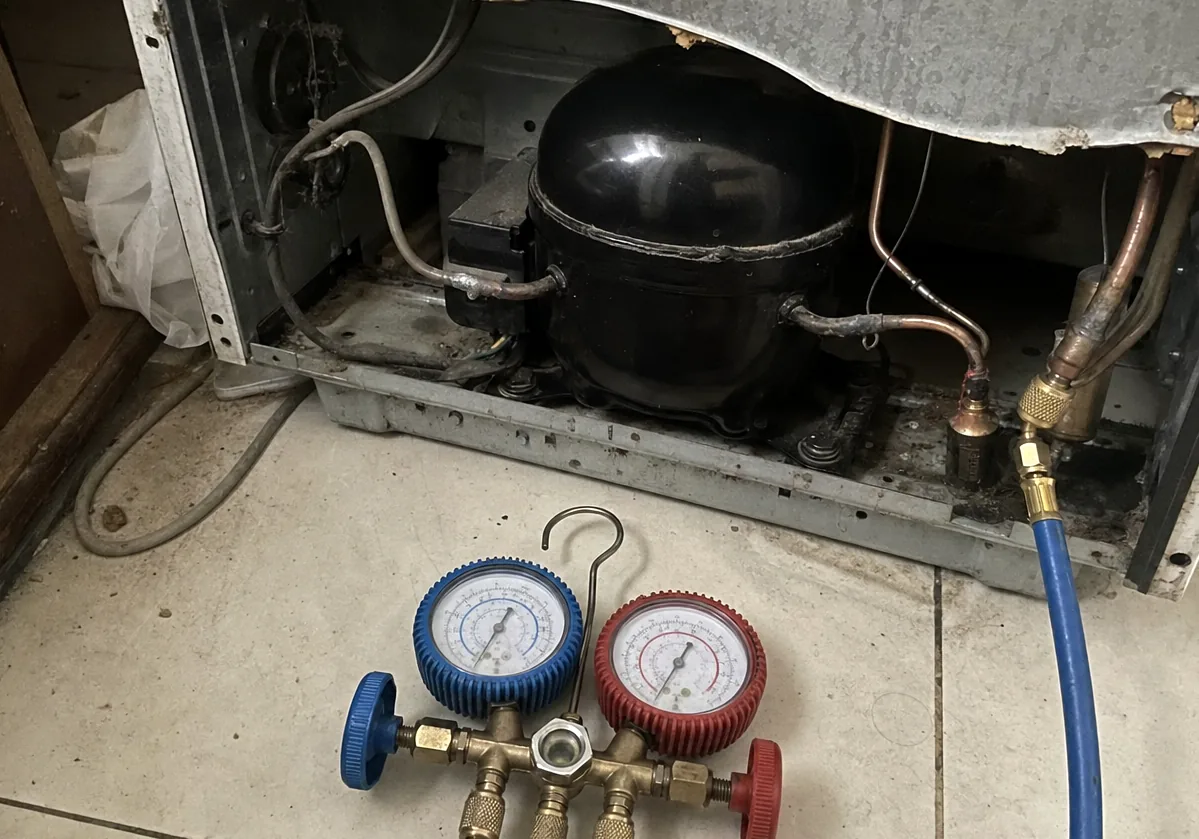
Sealed-system work is where the conversation changes. A leak in an accessible run of tubing is a repair like any other. A leak in an evaporator buried inside the cabinet insulation is a large job. A failed compressor sits between them, depending on the unit and which of its two systems has gone.
What should happen at that point is not a recommendation but a set of numbers: what the repair costs, what warranty it carries, what condition the rest of the appliance is in, and what a replacement of comparable specification would actually involve in your kitchen, panel and cabinetry included. Then you decide.
Three findings push us toward advising against the work. Corrosion or damage to the cabinet itself, because the box is the part that cannot be replaced. A second sealed-system failure on a unit that has already had one. And a repair cost that lands close enough to replacement that the remaining service life is doing all the work in the argument.
The age and the model family, the condition of the cabinet and the door furniture, whether the panel and the opening would still accept a current unit, whether the previous repairs were done properly, and what the appliance has been asked to do. A wine unit in a west-facing room and a built-in in a climate-controlled kitchen have not had the same fifteen years.
We also look at the rest of the house’s refrigeration while we are there. On Pace Island and around Doctors Lake there is often a built-in, a wine unit and undercounter drawers, all installed at once, all now the same age. Knowing that the other two are sound changes how you feel about spending on the first one.
The diagnostic is a flat fee, credited toward the repair if you go ahead, so the assessment does not cost extra when the answer is to proceed. The estimate is in writing before any part is ordered. Parts are genuine OEM. Labour carries 90 days and parts 365. Sealed-system work is performed by technicians holding EPA Section 608 certification for refrigerant handling.
And if the answer is that the appliance is finished, you get that in writing too, with the reasoning, at no further cost. We are an independent shop. We do not sell appliances, so nothing about that recommendation earns us anything either way.
The bands below are the ones this note is about. They are completed repairs, parts and labour together, on top of a flat diagnostic visit that is credited toward the work.
| Work | Typical range |
|---|---|
| $80 diagnostic visit | $80 |
| Compressor or sealed-system repair | $870–$2,460 |
Ranges, not quotes: the firm figure is written down after the diagnosis and nothing is ordered or billed until you have approved it. On this page the work we describe runs from $80 for the visit to about $2,460 at the top of the band above. The whole book of bands is on the pricing page.
A flat $80 covers the visit and the diagnosis. It is credited toward the repair if you go ahead with the work.
4.3 out of 5 across 62 customer reviews. Read every one of them.
The unit was running non stop and never quite reaching its setting. He weighed in the charge properly after the repair instead of guessing on gauge pressure, which the last firm did not bother with.
Alaric M.2026-06-27
He gauged the system, found it low, and was straight with us that a leak found once can be found again. We agreed to the work knowing that, and it has held temperature since he weighed the charge in.
Rowan F.2026-09-15
The work itself was careful and the unit is properly cold now. It took three appearances at the house to finish, and the reason for that was never explained to me in a way I could follow.
Petra M.2026-09-05