An older cabinet that two other shops had told us to scrap. He read the serial plate, sourced the correct evaporator for that run, and it has held its temperature through the whole summer since.
Desmond L.2026-04-11
Independent Sub-Zero specialists · Fleming Island, Clay County
Monday – Friday 8:00am – 6:00pm Call (904) 201-3304
The full-height built-in units that sit flush with the cabinetry — warm boxes, running fans, frost, water on the floor, doors that stopped sealing.
Built-ins are cabinetry as much as appliance. We work around the panels rather than through them.
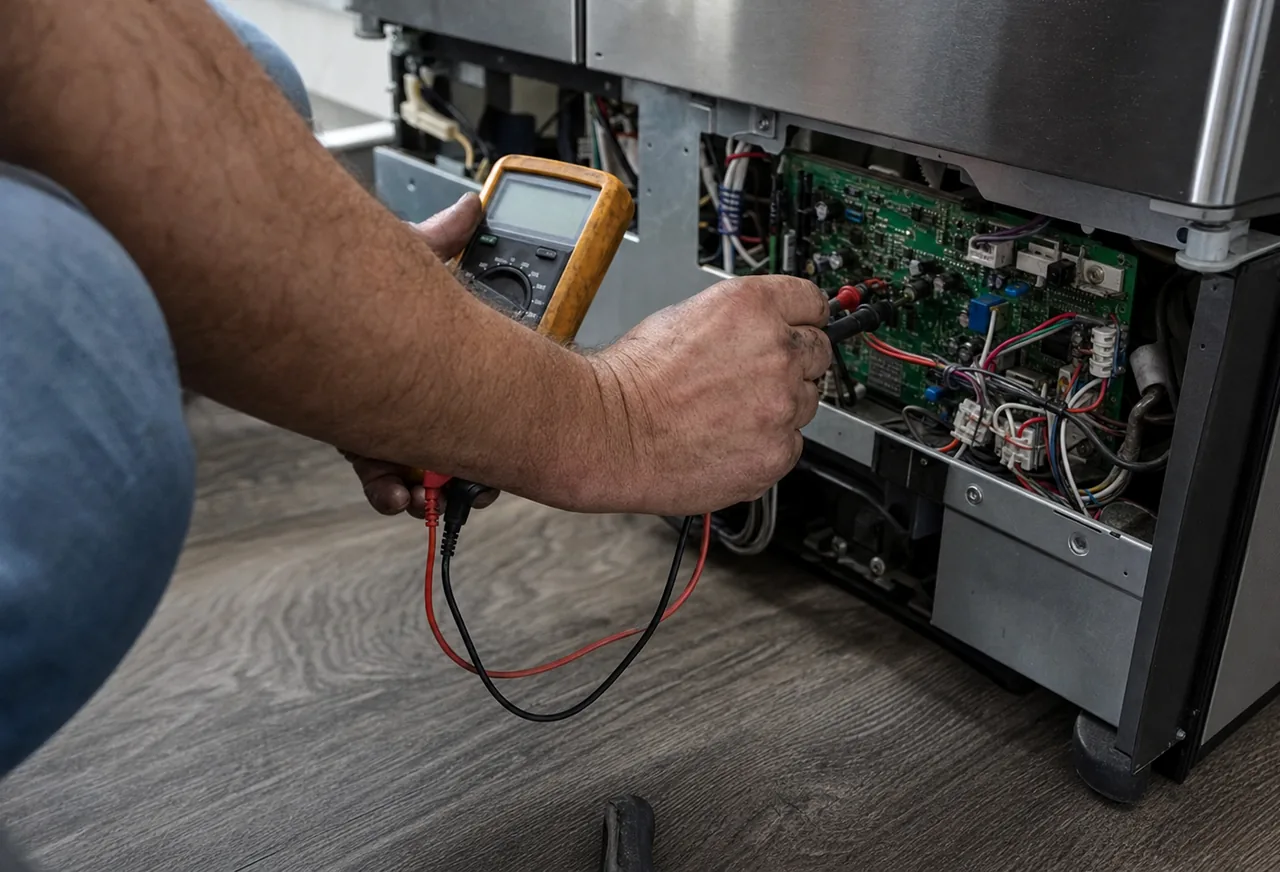
A Sub-Zero built-in is designed to outlast two or three ordinary refrigerators, and most of the ones we open are still mechanically sound. What has usually failed is one component inside a system that was built to be serviced: a fan, a defrost heater, a control board, a gasket that has taken fifteen years of Florida humidity.
Two sealed systems sit behind the grille — one for the fresh food compartment, one for the freezer. That is why a warm refrigerator and a cold freezer is such a common call, and why it is rarely the disaster it feels like. It usually points at one side of the machine, not the whole unit.
We start at the condenser. In a built-in the coil sits behind the upper grille where it collects dust, and in a house with dogs it collects considerably more than dust. A choked condenser makes the compressor work against itself, and the first symptom the owner notices is a unit that runs and runs without ever sounding like it has caught up.
From there the checks are ordinary and quick: evaporator fan, defrost cycle, drain line, door seal, and the temperature the box is actually holding rather than the temperature it is reporting.
The first is frost that keeps returning on the back wall of the freezer. It gets blamed on the defrost system, and sometimes that is right. But if the frost comes back within a week or two of a manual defrost, the more likely explanation in this climate is a door seal that has stopped making contact, letting humid air in to condense on the coldest surface it reaches. That is a cheap repair being mistaken for an expensive one.
The second is a unit that runs constantly. Owners hear it and assume the compressor is failing. Far more often the condenser cannot reject its heat — a choked coil, a blocked grille, or a cabinet return added above the appliance during a remodel that quietly halved the exhaust path. Nothing has broken; the kitchen changed around the appliance.
Northeast Florida sees something in the order of sixty-eight thunderstorm days a year, and built-in refrigeration electronics feel it. A unit that has gone blank, unresponsive, or that hums and refuses to start after a bad afternoon is usually a control or a start component rather than a compressor. We measure the supply voltage under load before condemning any board, because on older kitchens a shared or undersized circuit imitates a failing control convincingly.
Refrigerant work is the part of this trade that genuinely requires credentials. Our technicians hold EPA Section 608 certification for handling refrigerant, and a sealed-system diagnosis is never guessed at from a symptom list. If the problem turns out to be a leak or a failed compressor, you get the finding in writing along with what the repair costs and what it is worth against the age of the unit. Sometimes the honest answer is that the repair is not the right call.
Built-ins are joinery as much as refrigeration. The custom panel, the toe kick, the flush hinge and the cabinet opening around it all have to go back exactly as they came out. On older Fleming Island kitchens the opening is often tighter than the current specification allows, which matters if a unit ever has to come out on its rollers. We check clearance before anything moves.
The diagnostic is a flat fee and it is credited toward the repair if you go ahead. You get a written estimate before any part is ordered. Parts are genuine OEM, and the work carries a 90-day labour and 365-day parts warranty.
These are the bands this kind of fault lands in once it is diagnosed, parts and labour together. The visit comes off whichever line the job turns out to be.
| Work | Typical range |
|---|---|
| $80 diagnostic visit | $80 |
| Evaporator or condenser fan motor | $250–$600 |
| Door gasket or seal replacement | $250–$650 |
| Ice maker, water valve or supply line | $250–$620 |
| Defrost heater, thermostat or sensor | $260–$630 |
Ranges, not quotes: the firm figure is written down after the diagnosis and nothing is ordered or billed until you have approved it. On this page the work we describe runs from $80 for the visit to about $650 at the top of the band above. The whole book of bands is on the pricing page.
A flat $80 covers the visit and the diagnosis. It is credited toward the repair if you go ahead with the work.
Labour is warranted for 90 days and parts for 365 days from the date of the repair. Genuine OEM parts throughout.
We service Sub-Zero refrigeration only, as an independent shop. We do not service heating or air conditioning. No furnaces, no heat pumps, no air handlers, no mini-splits and no ductwork. That is a separate trade with its own licensing, and a call about a house that will not cool belongs with an HVAC contractor rather than with us.
4.3 out of 5 across 62 customer reviews. Read every one of them.
An older cabinet that two other shops had told us to scrap. He read the serial plate, sourced the correct evaporator for that run, and it has held its temperature through the whole summer since.
Desmond L.2026-04-11
The repair holds and the cabinet is quiet again. What I did not care for was being told the part would arrive at the start of the week and then hearing nothing at all until I chased it myself.
Marcus O.2026-08-06
After the last outage the cabinet came back up and then would not settle. Rather than sell me a control he checked the start components and found a condenser fan motor with a dragging shaft.
Isaac T.2026-07-06