Compressor was trying to start and dropping out on the overload. He measured the winding resistance in front of me, and when the reading came back open he did not pretend a relay would fix it.
Rufus G.2026-02-19
Independent Sub-Zero specialists · Fleming Island, Clay County
Monday – Friday 8:00am – 6:00pm Call (904) 201-3304
Refrigerant, compressors, condensers and evaporators — the part of the appliance that cannot be diagnosed from a symptom list and should never be guessed at.
Refrigerant work is the part of this trade that genuinely requires credentials. It is diagnosed with instruments, not with a guess.
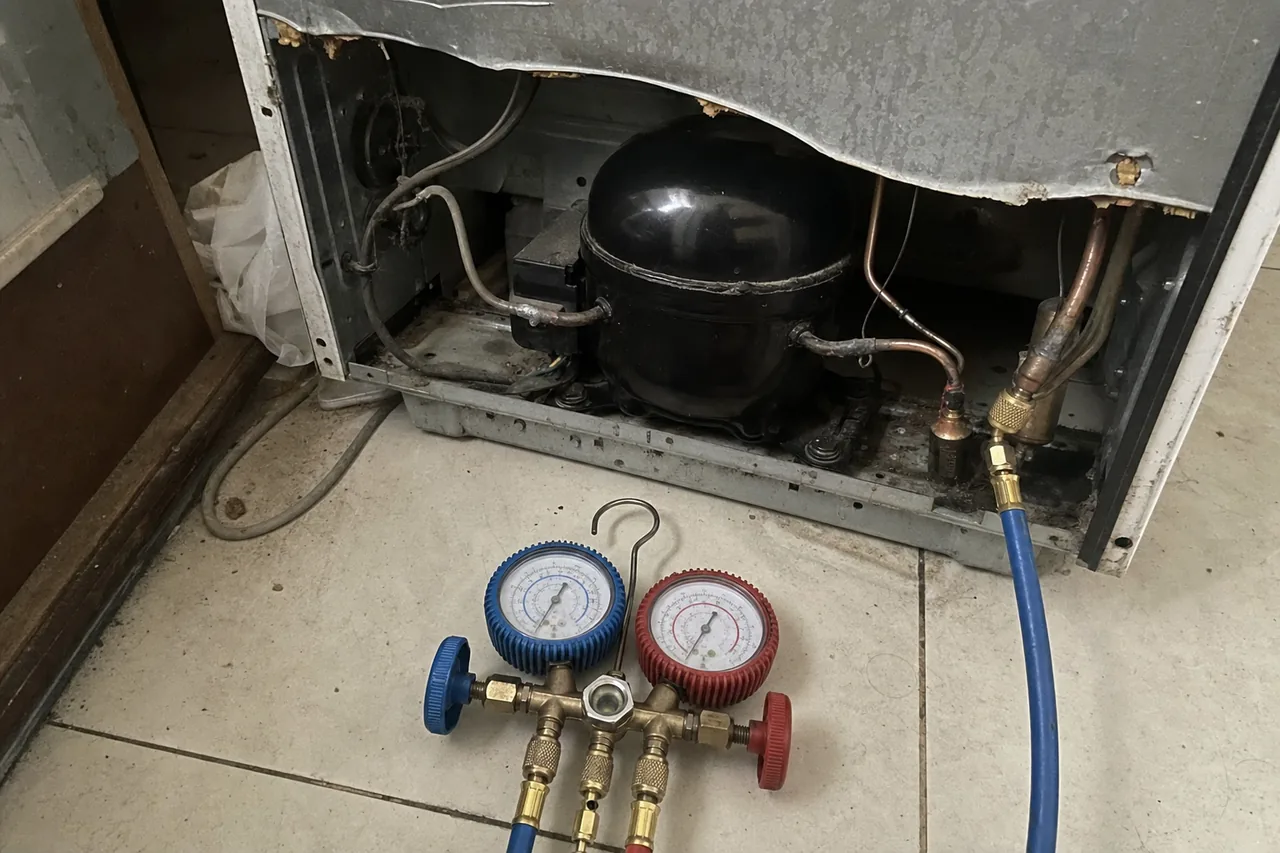
The sealed system is the closed loop that does the actual refrigerating: the compressor, the condenser, the metering device, the evaporator and the refrigerant charge moving between them. It is called sealed because opening it is a deliberate act with legal obligations attached, and it is the one area of appliance repair where a confident guess is worthless.
A Sub-Zero built-in of the classic pattern runs two independent sealed systems, one for the fresh food compartment and one for the freezer. That single fact explains the most common call we take. A refrigerator that has gone warm while the freezer stays hard-frozen is not a machine that has half-died. It is one of two systems reporting a problem, and it narrows the diagnosis enormously before we have opened anything.
It also explains its opposite. When both compartments climb together, the fault is more likely to sit outside the sealed systems altogether — the supply, the control board, the condenser they share, or the room the appliance is standing in.
Most calls that arrive described as a compressor problem are not one. In order, we check what the unit is actually holding against what it is reporting, the condition and airflow of the condenser, the evaporator fan, the defrost cycle, the door seals, and the voltage the appliance is receiving. A choked condenser coil produces the exact complaint that a failing compressor produces: runs constantly, never catches up, warm on hot afternoons.
Only when the ordinary causes are eliminated do we take pressures and temperatures and start reasoning about the charge. Our technicians hold EPA Section 608 certification for handling refrigerant, and that is the only certification claim this company makes.
If the finding is a leak, the useful question is where. A leak in an accessible run of tubing is a repair. A leak in the evaporator buried inside the cabinet insulation is a much larger job, and on an older unit it is often the point at which repair stops being the right economic call. A failed compressor sits somewhere between the two depending on the unit and its age.
You get that finding in writing, with the cost of the work set against what the appliance is and how old it is. Sometimes the honest recommendation is not to proceed, and we would rather say so than quote a repair that will not pay for itself. There is no benefit to us in selling sealed-system work on a cabinet that is finished.
Northeast Florida sees somewhere in the order of sixty-eight thunderstorm days a year. A compressor that hums, clicks and stops after a bad night of weather is often not a failed compressor at all but a failed start component or a control that has taken a hit. That is a far cheaper repair, and it is worth ruling in or out before anything else is considered. If your built-in is not on a surge-protected circuit, that is worth knowing regardless of what we find.
Recovery is not optional and it is not an upsell. Refrigerant removed from a system is recovered into approved equipment and handled under Section 608 rules. If a technician offers to vent a system to atmosphere to save you time, that is a reason to end the visit.
The diagnostic is a flat fee and it is credited toward the repair. Nothing is ordered and no labour is billed before you have approved a written estimate. Parts are genuine OEM, labour is warranted 90 days and parts 365 days. We are an independent shop and we work on Sub-Zero refrigeration only.
These are the bands this kind of fault lands in once it is diagnosed, parts and labour together. The visit comes off whichever line the job turns out to be.
| Work | Typical range |
|---|---|
| $80 diagnostic visit | $80 |
| Compressor or sealed-system repair | $870–$2,460 |
| Evaporator or condenser fan motor | $250–$600 |
Ranges, not quotes: the firm figure is written down after the diagnosis and nothing is ordered or billed until you have approved it. On this page the work we describe runs from $80 for the visit to about $2,460 at the top of the band above. The whole book of bands is on the pricing page.
A flat $80 covers the visit and the diagnosis. It is credited toward the repair if you go ahead with the work.
Labour is warranted for 90 days and parts for 365 days from the date of the repair. Genuine OEM parts throughout.
We service Sub-Zero refrigeration only, as an independent shop. We do not service heating or air conditioning. No furnaces, no heat pumps, no air handlers, no mini-splits and no ductwork. That is a separate trade with its own licensing, and a call about a house that will not cool belongs with an HVAC contractor rather than with us.
4.3 out of 5 across 62 customer reviews. Read every one of them.
Compressor was trying to start and dropping out on the overload. He measured the winding resistance in front of me, and when the reading came back open he did not pretend a relay would fix it.
Rufus G.2026-02-19
The unit was running non stop and never quite reaching its setting. He weighed in the charge properly after the repair instead of guessing on gauge pressure, which the last firm did not bother with.
Alaric M.2026-06-27
Cabinet ran without ever getting down to its setting. Before touching the sealed side he cleared a silted condenser and rechecked, which changed nothing, so the diagnosis was earned rather than assumed.
Cassius D.2026-08-29