The display was showing an alarm and I could not tell whether the wine was at risk. He read the stored history, found nothing wrong with the sealed side, and replaced a sensor that had drifted.
Maxine V.2026-08-23
Independent Sub-Zero specialists · Fleming Island, Clay County
Monday – Friday 8:00am – 6:00pm Call (904) 201-3304
Wine units drift before they fail. Uneven zones, a glass door that sweats through August, a fan that runs and runs, and racks that no longer sit true.
A wine unit rarely quits outright. It drifts, and the drift is what damages the contents.
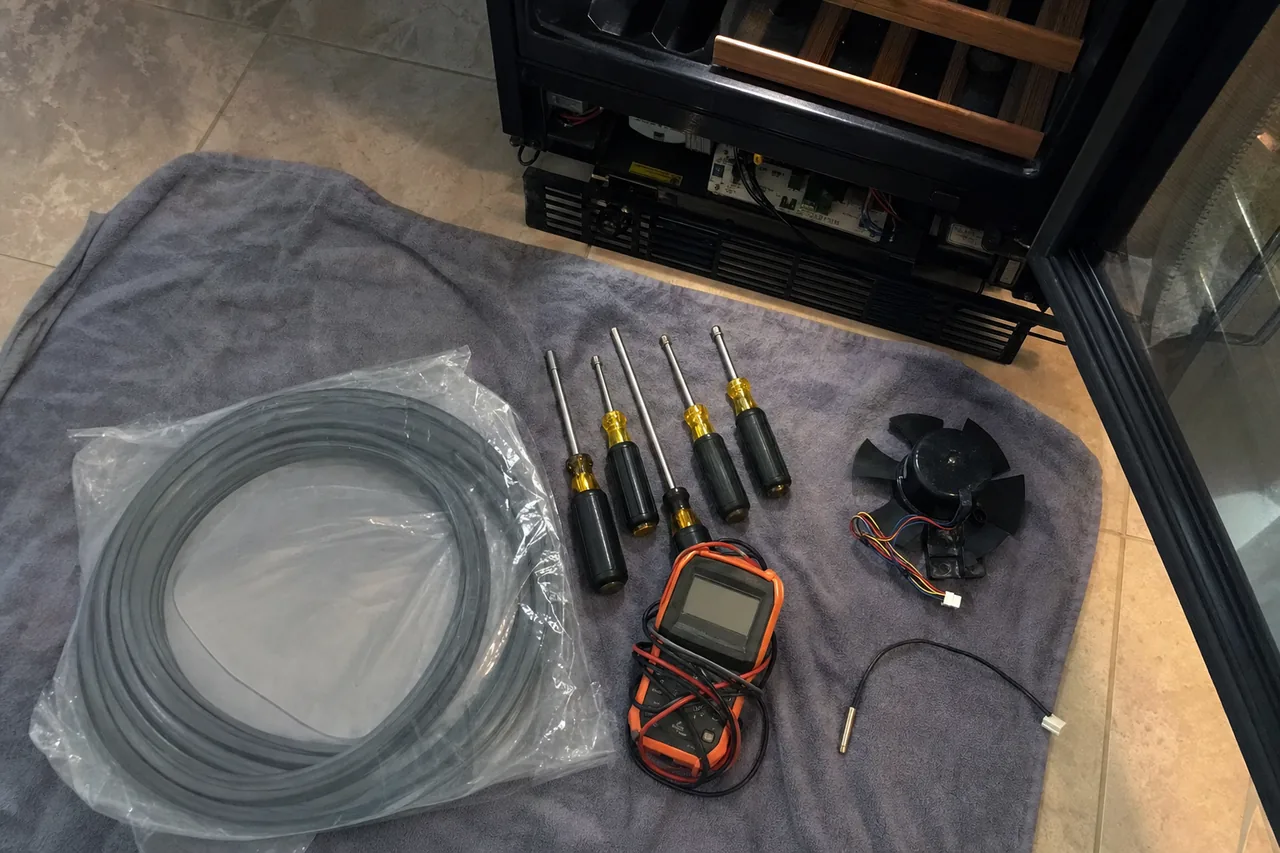
Wine storage fails quietly. A refrigerator that stops cooling announces itself within a day, but a wine unit holding six degrees above its set point can run that way for a season before anybody notices, and by then the damage is to the contents rather than the appliance. That is the argument for treating a temperature complaint on a wine unit as urgent even when nothing sounds wrong.
A dual-zone unit is one cabinet with two separately controlled spaces, and it keeps them apart with dampers, a divider and airflow rather than with two compressors. When the upper zone drifts and the lower one holds, the cause is usually in the way air is being moved and metered between them, not in the sealed system. A damper that has stopped travelling, a fan that has slowed, a sensor that is reading the wrong number, a rack loaded so tightly that air has no route through it.
The last of those is worth checking before you call anyone. Wine racks are designed with clearance in mind, and a shelf packed to the back wall in front of the outlet will produce exactly the pattern of warm top and cold bottom that looks like a failure.
Every wine unit with a glass door is a cold surface in a warm, damp room. In this climate that is a fair test of the door’s seal and its glazing. Light fogging at the edges on a very humid day is physics. Persistent condensation running down the inside of the glass, or water pooling on the front of the frame, means warm air is reaching the cold surface, and that points at the gasket, the hinge alignment or a door that has stopped latching square.
Houses along Doctors Lake and the St. Johns run humid year-round, and the kitchens that give us the most trouble are the ones where the wine unit sits near a door to a screened porch. Every time that door opens, the room the unit is fighting changes.
Vibration matters more here than it does in a refrigerator, because sediment and long-term storage are the whole point of the appliance. Wine units are built with that in mind, so a unit that has become audible has usually developed a mechanical fault rather than a design one: a fan blade catching, a compressor mount that has aged, a rack or a shelf that is no longer sitting in its detents, or a unit that has shifted slightly on an uneven floor. Some of that is a five-minute fix. Some of it is not, and you should know which before you pay for anything.
The interior lighting on a wine unit exists to be looked at, which means it is on more than it should be. An interior light that will not switch off is worth attending to promptly, both because it adds heat to the cabinet and because it usually indicates a door switch that thinks the door is open. That same switch can also be why the unit believes it should keep running.
Control faults on wine storage often present as a display doing something odd rather than as a cooling complaint. We read what the unit is actually holding with our own instrument before we accept what it is reporting.
We service Sub-Zero wine storage as an independent shop. The diagnostic is a flat fee, credited toward the repair if you go ahead, and you get a written estimate before a part is ordered. Parts are genuine OEM. Labour carries 90 days, parts 365.
If a wine unit is holding temperature and the complaint is really about capacity or layout, we will tell you that rather than sell you a repair. And if the sealed system has failed on an older unit, you get the cost of that work set against the age of the cabinet, in writing, before you decide. Sealed-system work is carried out by technicians holding EPA Section 608 certification for refrigerant handling.
These are the bands this kind of fault lands in once it is diagnosed, parts and labour together. The visit comes off whichever line the job turns out to be.
| Work | Typical range |
|---|---|
| $80 diagnostic visit | $80 |
| Electronic control board | $420–$840 |
| Evaporator or condenser fan motor | $250–$600 |
| Door gasket or seal replacement | $250–$650 |
| Defrost heater, thermostat or sensor | $260–$630 |
Ranges, not quotes: the firm figure is written down after the diagnosis and nothing is ordered or billed until you have approved it. On this page the work we describe runs from $80 for the visit to about $840 at the top of the band above. The whole book of bands is on the pricing page.
A flat $80 covers the visit and the diagnosis. It is credited toward the repair if you go ahead with the work.
Labour is warranted for 90 days and parts for 365 days from the date of the repair. Genuine OEM parts throughout.
We service Sub-Zero refrigeration only, as an independent shop. We do not service heating or air conditioning. No furnaces, no heat pumps, no air handlers, no mini-splits and no ductwork. That is a separate trade with its own licensing, and a call about a house that will not cool belongs with an HVAC contractor rather than with us.
4.3 out of 5 across 62 customer reviews. Read every one of them.
The display was showing an alarm and I could not tell whether the wine was at risk. He read the stored history, found nothing wrong with the sealed side, and replaced a sensor that had drifted.
Maxine V.2026-08-23
Upper shelves had crept above the setting while the bottom of the cabinet was fine. He cleaned a condenser thick with dust left by our flooring work, and the drift closed up again over the next day.
Ferdinand A.2026-09-16
The glass front fogged every humid afternoon and pooled on the lowest rack. A seal that had hardened at one corner was the whole of it, plus a catch that needed setting so the door draws in.
Bridget V.2026-02-09